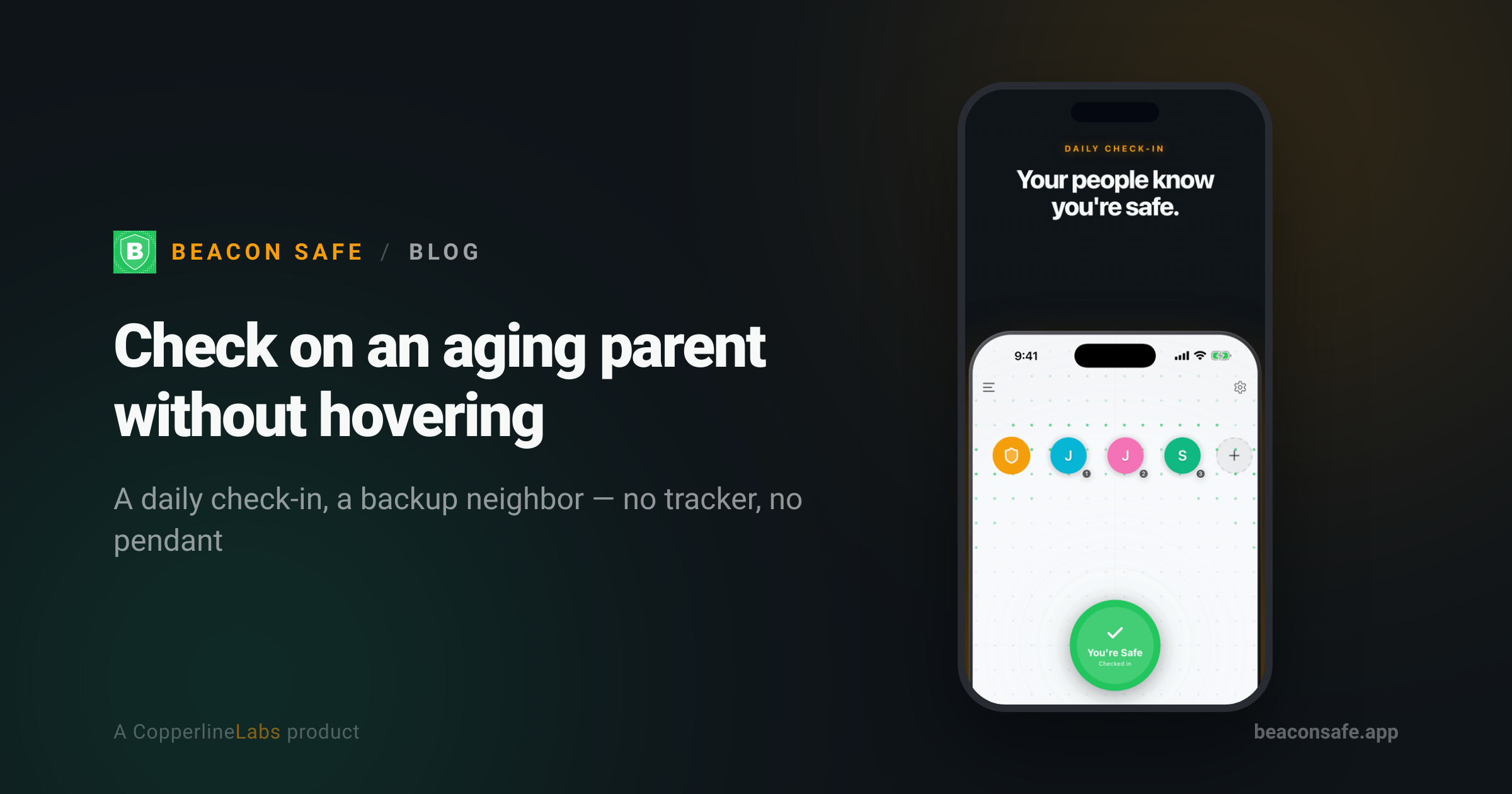
The easiest way to check on an elderly parent living alone is one daily check-in, not a string of phone calls. Agree on a single time they confirm they're okay, add a backup neighbor who can physically look in, and let a 2-hour grace period absorb a slow morning — so you find out if something's actually wrong, instead of just wondering.
The "just checking in" call that isn't, anymore
It starts small. A call after lunch, "just to see how you're doing." Then it's a text if she doesn't pick up. Then it's a second call twenty minutes later, and a third to a sibling asking if they've heard from her. None of it is dramatic in the moment, but it adds up to something neither of you signed up for: you checking constantly, and her feeling checked on.
That's the trap with informal check-ins — there's no agreed-upon signal for "I'm fine," so silence gets read as an emergency and a missed call gets read as surveillance. A daily check-in habit fixes both problems at once, because it replaces guesswork with one predictable moment.
Agree on one daily moment, not constant contact
Pick a time that already fits her day — after breakfast, before her afternoon show, whenever she'd naturally be up and moving. On Beacon Safe, you set a check-in for daily, every 48 hours, or every 72 hours, at a time you both choose together. If daily feels like too much for someone who's still independent and doesn't want to feel managed, every 48 hours is a reasonable middle ground.
The part that makes this work without feeling like a leash is the 2-hour grace period. A slow morning, a long shower, a neighbor who stopped by unannounced — none of that triggers anything. The deadline just sits there quietly until she taps "I'm okay," which for most people takes less time than answering a phone call.
Add a backup neighbor or a nearby friend
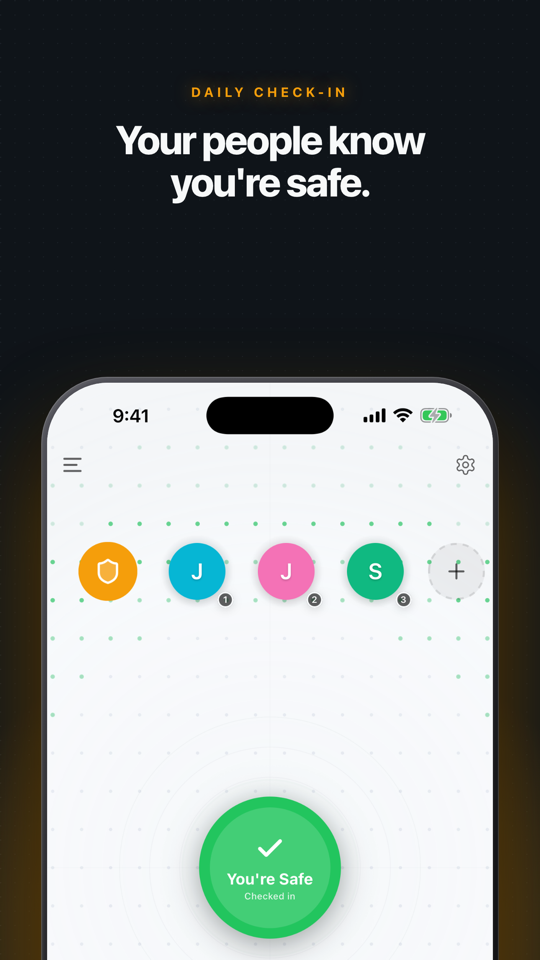
You're probably not local, and that's the whole reason this matters. If a check-in is missed, the first and best response usually isn't a call from three states away — it's someone who can knock on the actual door. Ask a neighbor, a friend from her church or her building, or a relative who lives closer if they'd be willing to be a backup contact. On the free tier you can add up to 3 emergency contacts; Plus extends that to 10, which is enough room for you, a sibling, and two or three people who are physically nearby.
None of them need to install anything. If she misses a check-in, contacts respond by tapping a secure link, replying to a text, or answering a phone call — no account, no app, no learning curve for the neighbor who's doing you a favor.
Make sure someone can actually get in
A check-in tells you something's wrong. It doesn't get anyone through a locked door. Before you rely on a daily check-in, make sure at least one nearby contact has a spare key, a lockbox code, or a landlord/building manager's number. This is the unglamorous part of the plan and the one people skip — and it's the difference between "we found out at 11 a.m." and "someone was actually inside by 11:15."
Skip the pendant, skip the tracker
Two alternatives usually come up, and it's worth being honest about both. A medical-alert pendant works well if she's willing to press a button in a fall or a crisis — but it does nothing if she can't reach it or doesn't want to wear it, and the monthly monitoring fees add up regardless of whether it's ever used. A location tracker solves a different problem entirely (knowing where someone is), and for a lot of parents that reads as exactly the kind of hovering you're trying to avoid.
A daily check-in threads the needle: Beacon Safe has no location tracking, ever — no GPS, no map, no movement history. It doesn't know where she is at 2 p.m. on a Tuesday, and it doesn't need to. It only reacts to whether she checked in by her deadline. That's a meaningfully different kind of "watching over," and it's usually the version an independent parent will actually agree to.
What actually happens if she misses it
Say the check-in comes and goes with no tap. Here's the real sequence: at the 2-hour mark past the deadline, her contacts get an email (and a text, if SMS is enabled) at the same time; if nobody responds, an automated voice call goes out about 5 minutes later; a follow-up notification fires around 4 hours after that if it's still unresolved; and a re-alert repeats at the 24-hour mark until someone confirms she's safe. On the Plus plan, Safety Check also tries reaching her directly first, before anyone else is alerted — so a forgotten tap doesn't turn into a wave of worried calls to the whole family.
The deadline itself runs on Beacon's servers, not on her phone, so it isn't dependent on her battery, her signal, or remembering to keep an app open in the background. If her phone is off or out of reach when the deadline hits, the alert still fires on schedule.
Setting it up together in five minutes
Do the setup with her, not for her — it's a five-minute conversation, and it goes better as a shared decision than a surprise notification she doesn't recognize. Install the app, add the contacts you agreed on, pick the check-in interval and time, and do one test run together so she knows exactly what the "I'm okay" tap looks like and what her contacts would actually see if she missed it. The free tier (3 contacts, email alerts, unlimited check-ins, $0) is enough to start; SMS and voice-call alerts are part of the Plus plan at $19.99 a month if you want the faster, multi-channel version.
For families who also want the fuller picture — how the server-side timer works, and why "no GPS" doesn't mean "no safety net" — the explainer on how these check-in apps work is a good next read.
The version of peace of mind that isn't surveillance
The goal was never to know where she is every hour. It was to stop wondering whether she's okay. A daily check-in gets you that without turning your relationship into a monitoring arrangement — one tap for her, one less thing on your mind, and an actual plan in place if the tap doesn't come.
Beacon Safe is not an emergency service and does not contact 911; in a life-threatening emergency call 911. Alert delivery depends on network availability.
Set up a daily check-in with your parent
A real free tier, no location tracking, ever — and a plan for who checks the door if a check-in is missed.